The Diploma in Procurement
For people already doing the job who want their development recognised, not just completed. It is 15 courses across the full procurement cycle, with every assignment reviewed by a practising procurement consultant and a Learning Manager keeping you on track.
- Courses
- 15 courses, 37 modules
- Study
- Allow about 108 hours
- Pace
- Your own, with a plan agreed at the start
- Assessment
- Workplace checklists and assignments reviewed by practitioners
- CPD hours
- 69.5
- Support
- A Learning Manager, monthly check-ins
- Next
- The Advanced Diploma
You know enough to know what you don't know
The Diploma assumes you have met the work: run a tender, managed a contract, worked a category. It fills the gaps and gives the job a structure. If you are new to procurement, start with the online courses and come back.
The full procurement cycle, course by course
15 courses and 37 modules, taken in this order. Open a course to see its modules and how long to allow.
Course 1Self-paced online courseCommercial Acumen
2 modules
1.5 CPD hoursallow about 2 h 15 min
Commercial Acumen
2 modules
Modules
- Setting up for Success
- Managing the Contracts
Time
Allow about 2 h 15 min of study. Your certificate records 1.5 CPD hours.
Course 2Self-paced online courseMarket Analysis
3 modules
2.5 CPD hoursallow about 4 h 30 min
Market Analysis
3 modules
Modules
- Introduction to Supply Market Analysis
- Research Methods
- Resources for Market Analysis
Time
Allow about 4 h 30 min of study. Your certificate records 2.5 CPD hours.
Course 3Self-paced online courseConflict Resolution for Procurement Professionals
1 module
1 CPD hourallow about 2 h
Conflict Resolution for Procurement Professionals
1 module
Modules
- Conflict Resolution for Procurement Professionals
Time
Allow about 2 h of study. Your certificate records 1 CPD hour.
Course 4Self-paced online courseCompetitive Tender Management
1 module
0.5 CPD hoursallow about 1 h
Competitive Tender Management
1 module
Modules
- Competitive Tender Management
Time
Allow about 1 h of study. Your certificate records 0.5 CPD hours.
Course 5Self-paced online courseSupplier Briefings
1 module
0.5 CPD hoursallow about 1 h 15 min
Supplier Briefings
1 module
Modules
- Supplier Briefings
Time
Allow about 1 h 15 min of study. Your certificate records 0.5 CPD hours.
Course 6Self-paced online courseSupplier Evaluation and Selection
3 modules, ending with an assessment
3.5 CPD hoursallow about 5 h 15 min
Supplier Evaluation and Selection
3 modules, ending with an assessment
Modules
- Definition and Process
- Execute the Framework and Reviewing Results
- Assessment
Time
Allow about 5 h 15 min of study. Your certificate records 3.5 CPD hours.
Training a team together? This also runs as an instructor-led workshop: Supplier Evaluation and Selection, for teams.
Course 7Self-paced online courseNegotiation in Procurement
1 module
1.5 CPD hoursallow about 2 h 15 min
Negotiation in Procurement
1 module
Modules
- Negotiation in Procurement
Time
Allow about 2 h 15 min of study. Your certificate records 1.5 CPD hours.
Course 8Self-paced online courseIntermediate Negotiation
5 modules, ending with an assessment
11 CPD hoursallow about 16 h 30 min
Intermediate Negotiation
5 modules, ending with an assessment
Modules
- The Negotiation Process
- Negotiation Planning
- Influencing a Negotiation
- Negotiation Outcomes
- Assessment
Time
Allow about 16 h 30 min of study. Your certificate records 11 CPD hours.
Course 9Self-paced online courseGuide to Negotiation and Persuasion
2 modules, ending with an assessment
3 CPD hoursallow about 4 h 45 min
Guide to Negotiation and Persuasion
2 modules, ending with an assessment
Modules
- Guide to Negotiation and Persuasion
- Assessment
Time
Allow about 4 h 45 min of study. Your certificate records 3 CPD hours.
Course 10Self-paced online courseA Step-by-Step Guide to Problem-Solving
1 module
2 CPD hoursallow about 3 h 45 min
A Step-by-Step Guide to Problem-Solving
1 module
Modules
- A Step-by-Step Guide to Problem-Solving
Time
Allow about 3 h 45 min of study. Your certificate records 2 CPD hours.
Course 11Self-paced online courseMentoring and Coaching for Results
1 module
2.5 CPD hoursallow about 3 h 45 min
Mentoring and Coaching for Results
1 module
Modules
- Mentoring and Coaching for Results
Time
Allow about 3 h 45 min of study. Your certificate records 2.5 CPD hours.
Course 12Self-paced online courseIntermediate Contract Management
8 modules, ending with an assessment
20 CPD hoursallow about 30 h 15 min
Intermediate Contract Management
8 modules, ending with an assessment
Modules
- Contract Set-Up
- Total Cost and Value Management
- Managing KPIs
- Supplier Performance Management
- Managing Amendments
- Negotiation and Influencing
- Contract Close-Out
- Assessment
Time
Allow about 30 h 15 min of study. Your certificate records 20 CPD hours.
Training a team together? This also runs as an instructor-led workshop: Intermediate Contract Management, for teams.
Course 13Self-paced online courseSupplier Performance Management
6 modules, ending with an assessment
9.5 CPD hoursallow about 14 h 30 min
Supplier Performance Management
6 modules, ending with an assessment
Modules
- Introduction to Supplier Performance Management
- Selecting Candidates and Enrolling Suppliers
- Planning for SPM
- Implementing SPM
- Wrapping Up
- Assessment
Time
Allow about 14 h 30 min of study. Your certificate records 9.5 CPD hours.
Training a team together? This also runs as an instructor-led workshop: Supplier Performance Management, for teams.
Course 14Self-paced online courseProcurement Success with Benchmarking
1 module
0.5 CPD hoursallow about 1 h
Procurement Success with Benchmarking
1 module
Modules
- Procurement Success with Benchmarking
Time
Allow about 1 h of study. Your certificate records 0.5 CPD hours.
Course 15Self-paced online courseAI in Procurement
1 module
10 CPD hoursallow about 15 h
AI in Procurement
1 module
Modules
- AI in Procurement
Time
Allow about 15 h of study. Your certificate records 10 CPD hours.
CPD hours are set under our CPD policy: the measured time for each course, rounded down to the nearest half hour.
Self-paced doesn't mean on your own
Every enrolment comes with a Learning Manager. They agree a study plan with you, check in monthly, and send your assignments to a practising procurement consultant, so your work is commented on by someone who has done the job.
For most learners, that is the difference between finishing and not.
A credential that shows you can do the work
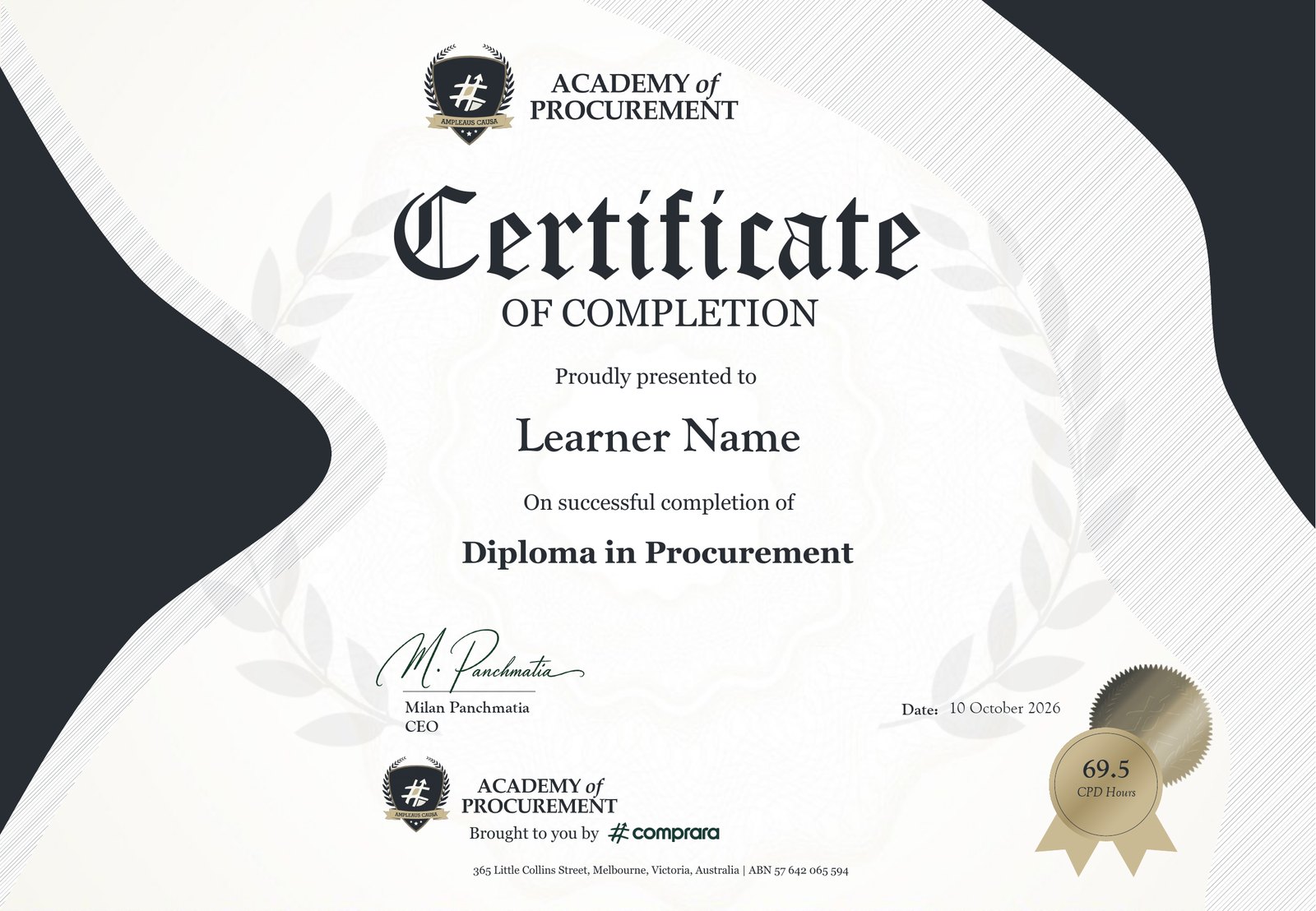
On completion you receive the Academy of Procurement Diploma as a digital credential you can add to LinkedIn and anyone can verify, with your CPD hours recorded.
The Diploma is the Academy's own qualification, and we stand behind it. It is written by practising procurement professionals, and every assignment is reviewed by one, not marked by a multiple-choice test.
Enrol online
Diploma in Procurement
15 courses, allow about 108 hours.
- All 15 courses and their assignments
- Learning Manager and monthly check-ins
- Practitioner review of every assignment
- Diploma credential and 69.5 CPD hours
Advanced Diploma
A separate qualification for more complex work. You need the Diploma first.
- 7 more courses: category management, sourcing, risk, total cost and stakeholders
- 78 CPD hours
- Its own credential
Prices in Australian dollars. GST is added for Australian buyers only. Employer paying for several people? Ask about a team enrolment.
Before you enrol
Who stands behind the Diploma?
We do. It is the Academy's own qualification: written and kept current by practising procurement professionals, with every assignment reviewed by one. It is not a nationally recognised qualification, and it is not accredited by an outside body.
How long does it take?
Allow about 108 hours of study across the 15 courses. Your Learning Manager agrees a timetable with you that fits around your work.
Is there a final exam?
No. Each course has a checklist for applying the learning at work, reviewed by your line manager, and assignments for the harder topics, reviewed by a practising consultant.
Do I need procurement experience?
Some, ideally. If you are new to procurement, start with the online courses and talk to a Learning Manager about when you're ready.
What is the Advanced Diploma?
A separate qualification you can take once you hold the Diploma: 7 more courses on category management, sourcing, risk, total cost of ownership and stakeholders, worth 78 CPD hours. See the Advanced Diploma.
Can my employer pay?
Yes. Pay by card and we'll send a tax invoice, or ask us to invoice your organisation for a group.
Not sure it's the right fit?
A 20-minute call with a Learning Manager. We'll tell you honestly.